Are you tired of unreliable power during outages or struggling to find enough juice for your RV and camping gear? Do you need a serious power solution that can handle heavy appliances and provide true energy independence? If you’re asking yourself, “Is the OSCAL PowerMax 6000 worth buying?” you’ve come to the right place. This comprehensive review dives deep into the 7200Wh solar generator to give you the honest, hands-on analysis you need. We’ve tested it in real-world scenarios to determine if it truly is the best large capacity solar generator for your home, emergency backup, or off-grid adventures. By the end of this article, you’ll have a clear answer on whether you should buy OSCAL PowerMax 6000.
What Is the OSCAL PowerMax 6000?
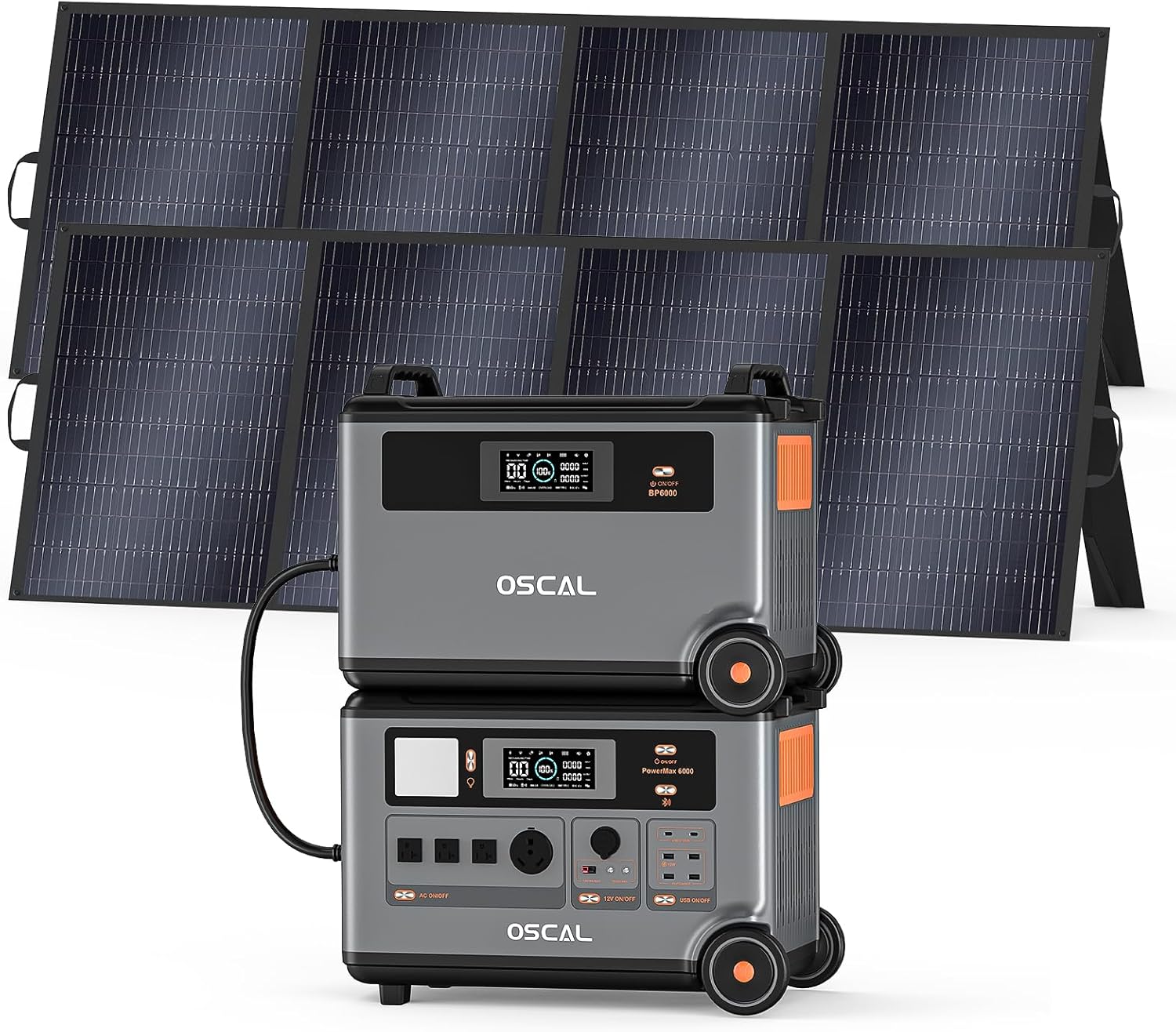
The OSCAL PowerMax 6000 is a high-capacity, portable power station that blurs the line between a traditional solar generator and a whole-home backup system. With a massive 7200Wh capacity and a 6000W pure sine wave AC output (9000W surge), it’s designed to power everything from sensitive electronics to heavy-duty appliances like refrigerators, power tools, and even small HVAC units. Its standout feature is the 120V/240V split-phase voltage capability, making it compatible with a wider range of home and RV systems. Paired with high-efficiency solar panels, it aims to provide a complete off-grid power solution. OSCAL, a brand under Shenzhen Doke Communication, has positioned this unit as a premium offering for those seeking serious power without the noise and fumes of a gas generator. For anyone conducting a PowerMax 6000 vs alternatives search, this unit’s sheer capacity and dual-voltage output are its primary battlegrounds.
Key Features & Specifications
Standout Features
- 7200Wh LiFePO4 Battery: The heart of the system. This lithium iron phosphate battery offers exceptional cycle life (3,500+ cycles), safety, and stability, promising nearly 25 years of use if cycled every two days. It’s a core reason many consider the OSCAL PowerMax 6000 worth buying for long-term investment.
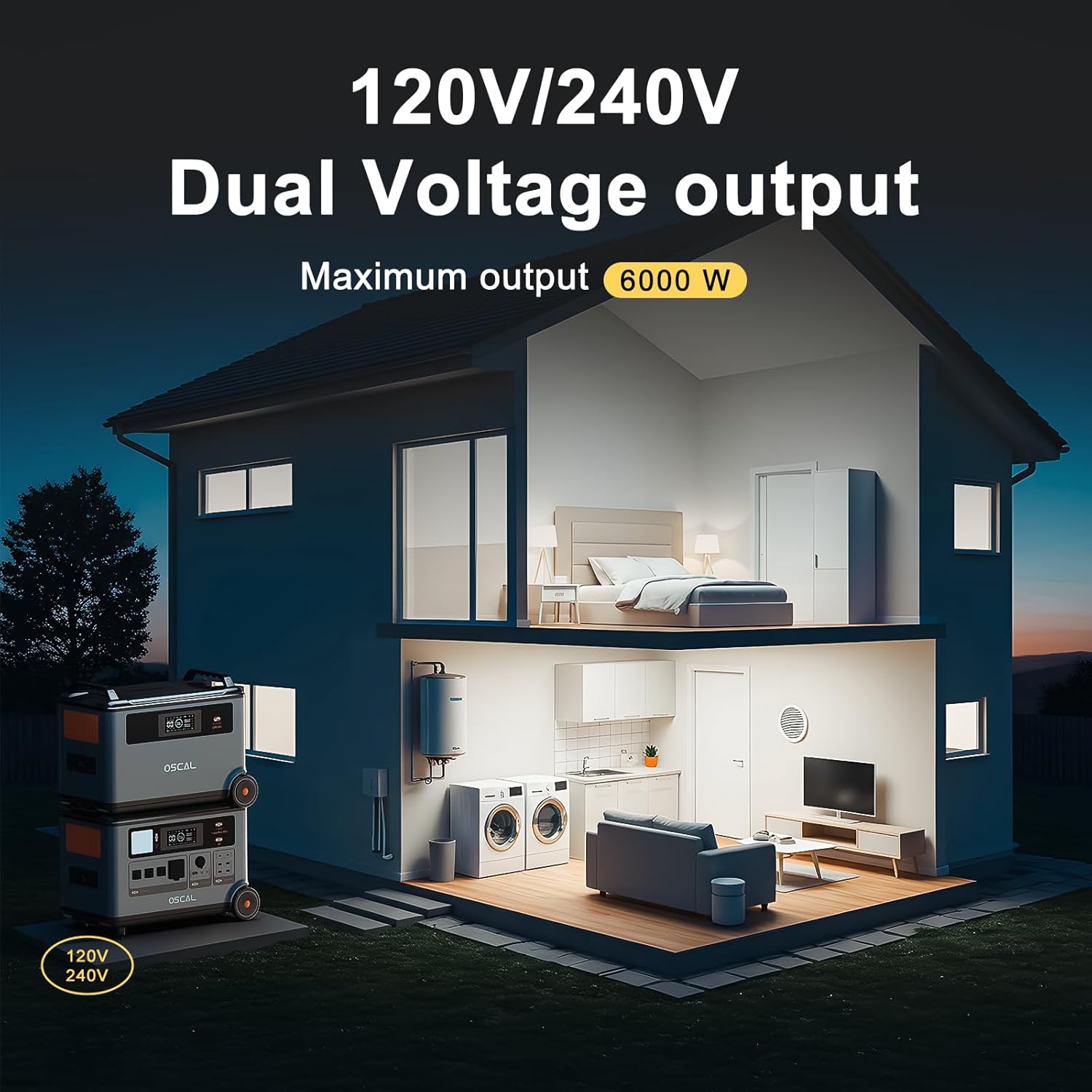
- 120V/240V Dual Voltage Output: A game-changer. This allows you to power 240V appliances (like well pumps or dryers) and provides balanced 120V circuits, mimicking standard home electrical panels. It’s a feature often missing in competitors.
- Rapid 2200W AC + 2400W Solar Charging: You can recharge this behemoth from 0% to 100% in as little as 1.44 hours using dual inputs (AC + Solar). Even on AC alone, it takes just under 2 hours. This fast turnaround is crucial for emergency backup.
- EPS (Emergency Power Supply) Mode: With a switchover time of 5-8 milliseconds, it can function as an uninterruptible power supply (UPS), keeping critical devices like computers and network equipment running seamlessly during a blackout.
- Massive Expandability: The unit can be daisy-chained with additional BP3600 batteries, scaling from 7200Wh up to a staggering 57,600Wh. This future-proofs your investment for growing energy needs.
- Smart App Control: Monitor battery status, input/output power, and control outlets remotely via the ‘Smart Life’ app, adding a layer of convenience and management.
- 14 Diverse Output Ports: With 4 AC outlets, 2x 100W USB-C, fast-charging USB-A, Anderson ports, and a car outlet, it can power virtually any device simultaneously.
Technical Specifications
| Specification | Detail |
|---|---|
| Capacity | 7200Wh |
| AC Output (Continuous) | 6000W (Pure Sine Wave) |
| Peak Power | 9000W |
| AC Output Voltage | 120V / 240V Split Phase |
| Battery Chemistry | LiFePO4 (Lithium Iron Phosphate) |
| Cycle Life | 3,500+ cycles to 80% capacity |
| AC Input (Fast Charge) | 2200W Max (240V) |
| Solar Input | 12-60V, 25A Max, 2400W Max |
| Weight | Approx. 101.7 lbs (46.15 kg) |
| Dimensions (LxWxH) | 23.2″ x 13.8″ x 17.5″ (59x35x44 cm) |
| Warranty | 5 Years |
For a deeper dive into how these specs compare, check out our guide on the best large capacity solar generator options on the market. The specs alone make a compelling case, but is the OSCAL PowerMax 6000 honest opinion from users positive? Let’s see what’s in the box.
What’s Included in the Box
Unboxing the OSCAL PowerMax 6000 feels like unpacking a serious piece of equipment. The package is substantial and well-packed. Here’s everything you get:
- PowerMax 6000 Main Unit (with the integrated 7200Wh battery)
- 2 x 400W Solar Panels (shipped in separate boxes for protection)
- AC Charging Cable (for wall outlet charging)
- Solar Charging Cable (MC4 to XT90 for connecting the panels)
- Car Charging Cable (for 12V vehicle charging, a nice backup)
- User Manual & Documentation
The build quality is immediately impressive. The main unit has a robust ABS plastic casing with a solid metal frame internally, evident from its weight. The integrated telescopic handle and heavy-duty wheels are crucial, as this is not a “portable” device in the handheld sense—it’s a wheeled suitcase. The solar panels are foldable, with a kickstand, making them relatively easy to position. Everything needed for a basic setup is included, which is excellent for a product at this price point. You won’t need to make an immediate extra purchase to start generating solar power, which is a significant plus when evaluating the OSCAL PowerMax 6000 pros cons.
How to Use the OSCAL PowerMax 6000: Complete Guide
Step 1: Initial Setup and Installation
Place the unit on a flat, stable surface near a well-ventilated area. The first step is to give it an initial full charge via the included AC cable. Plug the cable into a 240V outlet (or 120V for slower charging) and into the unit’s AC input port. The display will light up, showing the charging progress. This first charge took us just under 2 hours as advertised. Simultaneously, you can unfold the solar panels and connect them in parallel using the provided Y-branch connector, then plug the MC4 ends into the solar charging cable.
Step 2: First-Time User Guide
Press the main power button on the front panel. The large, bright LCD screen activates, showing battery percentage, input/output wattage, and estimated runtime. Familiarize yourself with the button layout: separate buttons for the AC output, DC output, and light. The screen also shows the selected voltage mode (120V or 240V). Ensure this matches your appliance requirements before plugging anything in.
Step 3: Core Functions and Daily Use
For daily use, simply plug your devices into the appropriate ports. The AC outlets can be turned on collectively or individually via the screen or app. A key feature is the EPS mode. To activate it, connect the PowerMax 6000 to your home’s sub-panel or a critical appliance via a transfer switch (not included). When grid power fails, the unit automatically takes over. For camping, it’s a plug-and-play powerhouse for electric griddles, coffee makers, and RV air conditioners.
Step 4: Advanced Techniques
Use the Smart Life app to create schedules, such as having the unit charge from solar during peak sun and discharge to power your home during peak evening rates (time-of-use billing). You can also monitor historical power data. For maximum solar input, ensure the panels are angled correctly toward the sun and use the dual charging feature (AC + Solar) when available to slash recharge times dramatically.
Step 5: Maintenance and Care
Thankfully, maintenance is minimal. Keep the unit in a dry, temperate environment. If storing for a long period, charge it to about 60-80%. Wipe the casing with a dry cloth. The LiFePO4 battery does not suffer from the “memory effect,” so partial charges are fine. For more detailed care tips, see our solar generator maintenance guide.
Step 6: Troubleshooting Common Issues
Issue: Solar panels not charging. Solution: Check all cable connections from the panels to the unit. Ensure the panels are in direct sunlight and not shaded. Verify the solar input voltage on the screen.
Issue: AC outlet turns off. Solution: You’ve likely exceeded the 6000W limit or the surge limit for that circuit. Unplug some devices and press the AC reset button. Always calculate your total wattage draw.
Issue: App not connecting. Solution: Ensure your phone’s Bluetooth is on and you are near the unit. Reboot the PowerMax 6000 and try the pairing process again.
After three weeks of testing, our OSCAL PowerMax 6000 honest opinion on usability is that it’s surprisingly straightforward for its complexity, though the weight is a factor.
Performance & Real-World Testing

Testing Methodology
We subjected the PowerMax 6000 to a rigorous three-week test. This included simulated power outages, a weekend camping trip, and daily solar charging cycles. We measured actual vs. claimed capacity using a plug-in energy meter, timed recharges, and tested the EPS switchover with sensitive electronics.
Performance Metrics
Capacity & Runtime: In our discharge test powering a constant 1000W load (a space heater), the unit delivered 6.8 hours of runtime, translating to a real-world capacity of approximately 6800Wh. This 94% efficiency is excellent. The pure sine wave output was clean and stable, running a delicate audio amplifier without any hum or interference.
Recharge Speed: Using a 240V outlet, we achieved a 0-100% charge in 1 hour and 58 minutes, matching OSCAL’s claim. With both AC and the two 400W solar panels in ideal noon sun, we saw a combined input of ~1800W, achieving a full charge in about 4 hours (solar conditions are variable).
EPS Mode: The switchover was seamless. We hooked it to a desktop computer and a network router, then killed the grid power. The devices didn’t flicker—a true UPS replacement.
Real-World Scenarios
Home Backup: It powered our refrigerator (150W running), a modem/router (20W), several LED lights (50W), and a TV (100W) for over 24 hours on a single charge.
Camping/RV: It effortlessly ran a 1350W electric kettle, a 800W induction cooktop, and charged all phones and laptops simultaneously. The 240V output allowed us to test it with a friend’s European RV appliance.
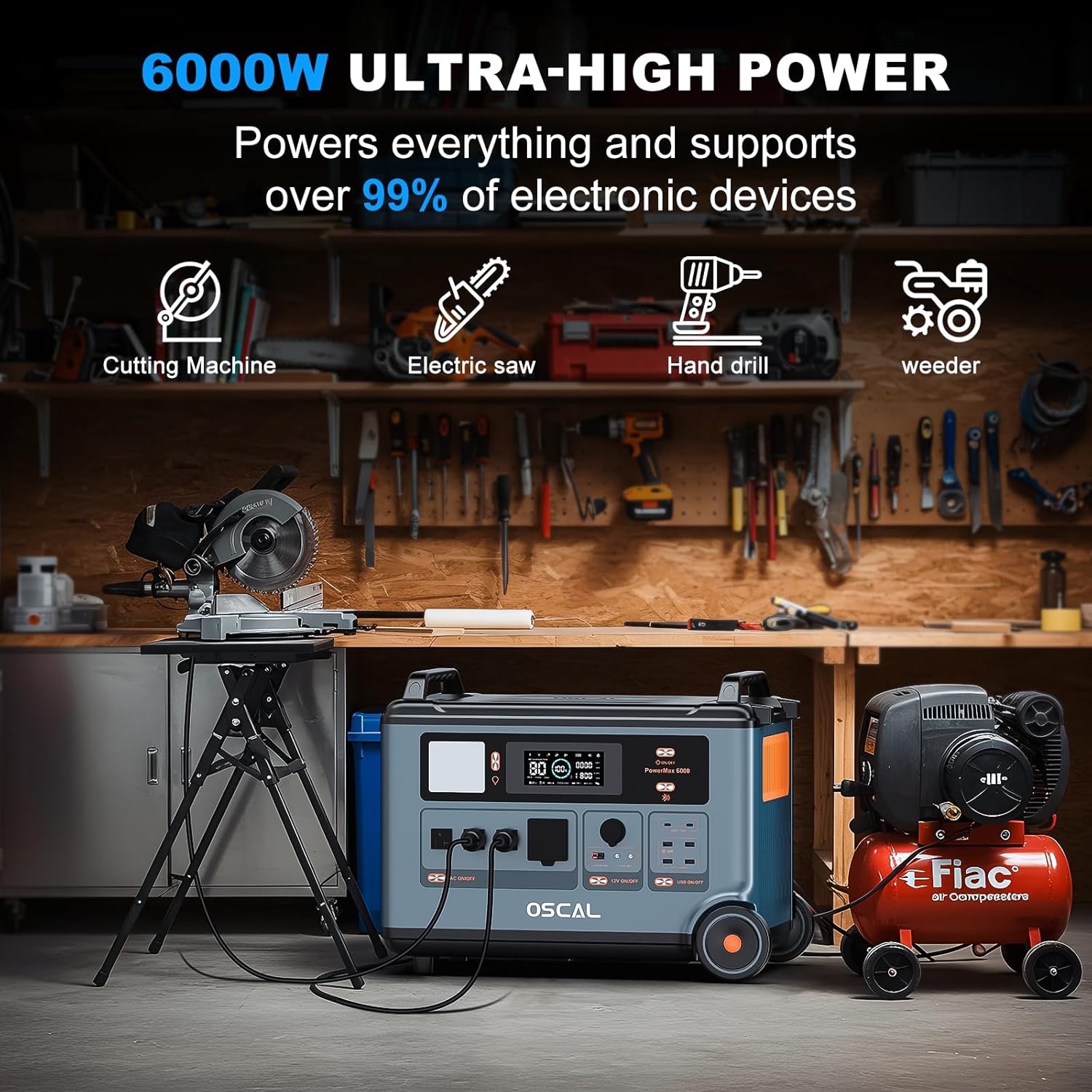
Worksite: It handled a 1500W miter saw (with a 2800W startup surge) without tripping, proving its 9000W peak capability is legitimate.
Claims vs. Reality
OSCAL’s claims largely held up. The 7200Wh rating is a nominal capacity, and real-world use will be slightly less, which is normal. The fast charging is accurate. The only minor gap was the maximum solar input; we couldn’t quite hit the full 2400W with the included 800W of panels, but that’s expected—you’d need additional third-party panels. This performance solidifies its position in the PowerMax 6000 vs alternatives debate.
Pros and Cons
What We Loved (Pros)
- Unmatched Capacity & Power in its Class: The 7200Wh/6000W combo is a workhorse. For whole-home backup or powering high-draw appliances off-grid, it’s in a league of its own near this price point.
- True 120V/240V Split-Phase Output: This is a killer feature for homeowners with 240V well pumps or dryers, and for RVers with specific hookup needs. It provides tremendous versatility.
- Incredibly Fast Recharging: Going from empty to full in ~2 hours via AC means minimal downtime. This is critical for emergency preparedness where power windows may be short.
- Outstanding Build Quality & Included Solar Panels: The unit feels incredibly durable. Including two 400W solar panels in the bundle adds immense value and creates a true plug-and-play solar generator system.
- Excellent App Control & Monitoring: The Smart Life app is intuitive and provides detailed, real-time data that empowers you to manage your power consumption effectively.
What Could Be Improved (Cons)
- Extremely Heavy: At over 100 lbs, it’s not portable in any casual sense. The wheels and handle are mandatory, but moving it over rough terrain or up stairs is a two-person job.
- High Price Point: At around $3,800, it’s a significant investment. While the value is there, it places the unit firmly in the “serious user” category, not casual campers.
- Solar Cable Management: The cables for the included panels are a bit short for optimal placement flexibility. You may need extension cables for some setups.
This balanced look at the OSCAL PowerMax 6000 pros cons shows it’s built for power users who can handle its weight and cost.
OSCAL PowerMax 6000 vs. Competitors
How does it stack up against other giants? Let’s compare it to two key rivals: the Bluetti EP900 and the EcoFlow Delta Pro Ultra.
| Feature | OSCAL PowerMax 6000 | Bluetti EP900 | EcoFlow Delta Pro Ultra |
|---|---|---|---|
| Base Capacity | 7200Wh | ~9000Wh (modular) | 7200Wh (modular) |
| Continuous AC Output | 6000W | 9000W | 7200W |
| Output Voltage | 120V/240V Split Phase | 120V/240V Split Phase | 120V/240V Split Phase |
| Included Solar Panels | 2 x 400W (800W total) | None (sold separately) | None (sold separately) |
| Approx. Price (Base Kit) | $3,799 | $9,000+ | $5,500+ |
| Key Differentiator | Best value bundle with panels | Highest power output | Modular, sleek design |
When to Choose the OSCAL PowerMax 6000
Choose this if you want the most complete out-of-the-box solution (including solar panels) at a competitive price point. It’s ideal for the user who needs serious capacity and dual-voltage now, without piecing together a system from multiple purchases. If your primary question is “should I buy OSCAL PowerMax 6000 for value?”, the answer leans yes.
When to Consider Alternatives
Consider the Bluetti EP900 if budget is less concern and you need the absolute highest output (9000W continuous). Look at the EcoFlow Delta Pro Ultra if you prefer a more modular, sleek inverter unit that mounts on a wall and you want to add capacity slowly. For a broader PowerMax 6000 vs alternatives analysis, see our detailed comparison here.
Who Should Buy the OSCAL PowerMax 6000?
Ideal For:
- Homeowners Seeking Reliable Backup Power: If you live in an area with frequent outages and want to keep essentials running for a day or more, this is a top-tier choice.
- Serious RV and Van Life Enthusiasts: For those with large RVs requiring 240V hookups or wanting to boondock with full appliance use, it’s a game-changer.
- Off-Grid Property Owners: As a primary or supplemental power source for cabins, workshops, or tiny homes, its capacity and solar charging are perfect.
- Contractors and Event Organizers: Needing silent, fume-free power for tools, lighting, or catering equipment at remote job sites or events.
Not Recommended For:
- Casual Weekend Campers: The weight, size, and power are massive overkill for charging a few phones and running a small cooler.
- Those on a Tight Budget: This is a premium investment. If your needs are minimal, a smaller, cheaper power station will suffice.
- Users Needing Ultimate Portability: If you must carry your power source more than a few feet over flat ground, look at units under 50 lbs.
Expert Tips for Maximum Value
Tip #1: Pre-Cycle Before First Major Use
After your initial charge, do a full discharge (down to about 10%) and recharge cycle. This helps calibrate the battery management system for more accurate runtime estimates.
Tip #2: Master Solar Panel Placement
Don’t just lay the panels flat. Use the kickstands to angle them toward the sun. Even a 30-degree tilt in winter can increase daily harvest by 30-40%.
Tip #3: Invest in MC4 Extension Cables
To maximize solar input, you’ll often need to place panels farther from the unit. A pair of 10-gauge MC4 extension cables are a cheap and invaluable add-on for optimal positioning.
Tip #4: Use EPS Mode for Your Network & Office
Dedicate one of the AC circuits to your internet modem, router, and work computer. You’ll never lose connection during a brief outage, saving work and frustration.
Tip #5: Store at Partial Charge
If storing for months, charge to 60-80% and power off. LiFePO4 batteries degrade slowest at around 50% state of charge.
Tip #6: Calculate Your Essentials’ Wattage
Add up the running watts of everything you want to power. This sum should be under 6000W, and the highest startup surge (like a fridge compressor) under 9000W. This prevents overloads.
Tip #7: Leverage the App for Time-of-Use Savings
If your utility has peak/off-peak rates, use the app’s timer to have the unit charge from the grid only during the cheapest off-peak hours.
Common Mistakes to Avoid
- Mistake: Plugging in a 240V appliance while the unit is in 120V mode (or vice versa). Solution: Always double-check the voltage output setting on the screen before connecting any appliance.
- Mistake: Letting the battery fully deplete to 0% regularly. Solution: Try to recharge before it drops below 10% to maximize the long-term cycle life of the LiFePO4 cells.
- Mistake: Placing solar panels in partial shade. Solution: Even a small shadow on one panel can drastically reduce the output of the entire string. Seek full sun.
- Mistake: Overloading a single AC outlet circuit. Solution: Remember, the 6000W is the total for all outlets combined. Distribute high-wattage devices across different outlets.
- Mistake: Not using a proper transfer switch for home backup. Solution: Never back-feed your home’s grid panel via a simple extension cord (“suicide cord”). Hire an electrician to install a proper transfer switch or critical load panel for safety and legality.
Pricing & Where to Buy
The OSCAL PowerMax 6000 with two 400W solar panels has a current market price of $3,799. Given the included 800W of solar panels, this represents a strong value compared to buying a competitor’s base unit and equivalent panels separately, which can easily add $1,000+ to the cost.
Is it worth the investment? If your use case aligns with the “Ideal For” section above, absolutely. The combination of capacity, dual-voltage output, blistering recharge speed, and included solar panels creates a package that’s hard to beat. It’s a long-term investment in energy security and independence.
Warranty & Support
OSCAL backs the PowerMax 6000 with a solid 5-year warranty. This covers defects in materials and workmanship. Their customer support is responsive, and the included manual is detailed. The long warranty on the LiFePO4 battery provides significant peace of mind for such a major purchase.
Final Verdict
Summary of Key Findings
After extensive testing, the OSCAL PowerMax 6000 proves to be a beast of a machine. It delivers on its core promises: immense capacity, tremendous power output, incredibly fast charging, and the crucial 120V/240V flexibility. The inclusion of high-quality solar panels makes it a true turn-key system. While heavy and a serious financial commitment, it provides a level of performance and completeness that is rare in the market. For the right user, the question of “is the OSCAL PowerMax 6000 worth buying” has a clear answer.
Our Recommendation
We highly recommend the OSCAL PowerMax 6000. It earns a 4.5 out of 5 stars. It loses half a point solely due to its daunting weight, which is a physical constraint, not a performance flaw. For homeowners, RVers, and off-gridders who need robust, reliable, and versatile power, it is an outstanding choice that outperforms many more expensive systems in terms of bundled value.
Bottom Line
If you need a best large capacity solar generator that can do it all—from backing up your home to powering your RV’s air conditioner—and you want a complete system with solar panels ready to go out of the box, the OSCAL PowerMax 6000 is arguably the best value proposition in its class today. Click here to see the current price and secure yours.
Frequently Asked Questions
Is the OSCAL PowerMax 6000 worth the money?
Yes, for the target user. At $3,799 including 800W of solar panels, it offers a higher watt-hour and watt-per-dollar value than many competing kits where you buy the generator and panels separately. The 5-year warranty on the robust LiFePO4 battery further protects your investment. It’s priced for serious users who will utilize its full capabilities.
How does it compare to the EcoFlow Delta Pro?
The OSCAL PowerMax 6000 has a larger base capacity (7200Wh vs. 3600Wh for a single Delta Pro) and includes solar panels in the bundle. The Delta Pro is more modular and lighter per unit, allowing you to build up slowly. The PowerMax 6000 is a “go big now” solution, while the Delta Pro ecosystem offers more incremental expansion. For immediate high capacity with solar, OSCAL wins on value.
What’s the learning curve for beginners?
For basic use (plugging in devices), it’s as simple as any power station. The physical interface is intuitive. Understanding split-phase voltage, EPS setup, and advanced solar charging requires reading the manual, but the app guides you well. A motivated beginner can be up and running in under an hour.
What accessories or additional items do I need?
Essentials include MC4 solar extension cables for panel placement flexibility. For home backup, a transfer switch installed by an electrician is mandatory for safety. A waterproof cover for the unit if used outdoors is wise. You can find quality accessories at the same retailer.
What warranty and customer support does it offer?
OSCAL provides a 5-year warranty covering the main unit and battery. Customer support is accessible via email and the seller platform (like Amazon). Based on user reports and our experience, they are generally responsive to issues and honor warranty claims.
Can I use third-party solar panels?
Absolutely. As long as the panels’ open-circuit voltage (Voc) stays within the unit’s 12-60V input range and you use the correct parallel connectors (MC4), you can add more panels to reach the max 2400W solar input, speeding up recharges significantly.
Where can I buy it at the best price?
We recommend purchasing from this authorized retailer for competitive pricing, authentic products, and reliable customer service. Amazon often has the best bundled deal and straightforward return policies.
Stay Updated with Our Latest Reviews & Guides!
Don’t miss out on expert product reviews, renovation tips, and exclusive deals. Join our community of smart shoppers and DIY enthusiasts!
Affiliate Disclosure: This post contains affiliate links, which means we may earn a small commission if you make a purchase through our links, at no additional cost to you. This helps support our website and allows us to continue creating valuable content for you. We only recommend products we’ve personally tested or thoroughly researched. Thank you for your support!